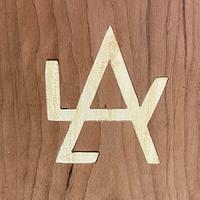
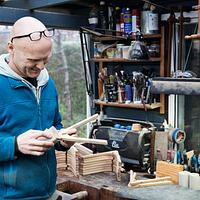
I have a large selection of veneer due to having made custom table tennis paddles for years. But for this clock where the form is the star (literally and figuratively), I wanted to select a veneer that had a grain pattern that wouldn't compete for attention. I may make another one later where I get a bit more bold with the pattern, but for this initial one I'm going to approximate the variation of the clock in my Introduction post. I'll use holly to wrap the hub. It has a creamy white color with subtle grain pattern.
I cut a piece that would overlap the sides and ends when wrapped around the hub.
I'm going to use the ironing technique where both surfaces are coated and the glue allowed to tack-up before joining them and ironing out the remaining moisture in the glue. I got the glue roller out, but ended-up using a chip brush to apply the glue. The line on the plywood core marks the top of the clock. Since the top will be above eye level when hung on the wall, that's where I'll seam the veneer.
The holly curled quite a bit once the glue was applied, but didn't fight being tacked down with the iron and became more manageable after that.
With one end extended past the seam location, started ironing about an inch away on the other side of the seam, continuing around the hub.
With most of the veneer ironed down, I could cut the excess from both ends where they overlap. I should have cut this seam at an angle to form a scarf joint. My perpendicular cut left me with a fraction too much length, which I didn't find out until later when trying to iron-down a buckle in the veneer.
I ended up having to re-trim one end of the veneer to ease the buckle, and of course I removed too much material, leaving a small gap. Also, you can see what looks like a pair of dents just to the right of my thumb. I think the final ring of the hub must have distorted during glue-up. I don't see any misalignment inside, so I'm not really sure what happened. Fortunately, it's behind where the spikes will mount, so I'm not too concerned. Some scraping and sanding ought to minimize the effect. I will want to address that gap at some point, though.
I trimmed the excess veneer along the edges, leaving a little standing proud to sand down flush.
I taped-off the veneered sides prior to veneering the face in order to avoid any glue smudges from my fingers. I marked and cut a veneer disk for the top with what I assumed would be a generous excess.
Gluing the face veneer was easier, but the veneer shifted as I was ironing and I almost didn't have full coverage on the face. There was probably 1/32" of overhang on one side. Whew!
Trimmed up and sanded.
I used a brad point bit, hand-turned from the inside to poke through the veneer on the outside. I used a round riffler file to carefully shape the holes.
I can't resist a dry fit at this point, so I start attaching the spikes. A mini-ratchet works perfectly for this.
Going around like that and dealing with the curl of the holley (perpendicular to the way you want!) is something I've never tried. You make it look easy, albeit no audio here to cringe to!
Overall fit up seems to be perfect, great planning!
Going around like that and dealing with the curl of the holley (perpendicular to the way you want!) is something I've never tried. You make it look easy, albeit no audio here to cringe to!
Overall fit up seems to be perfect, great planning!
The ironing process got a little frantic when the trimmed ends wouldn't line-up right, but even with the flaws I'm satisfied with the result. Yes, the CNC is a nice tool to have in the arsenal.
Have you ever tried hot hid glue for veneer applications?
I have the melting pot and the hide granules, and I've tried it a couple time, but haven't been successful using it yet. I do need to spend some more time practicing with it.
The ironing process got a little frantic when the trimmed ends wouldn't line-up right, but even with the flaws I'm satisfied with the result. Yes, the CNC is a nice tool to have in the arsenal. ...
I have the melting pot and the hide granules, and I've tried it a couple time, but haven't been successful using it yet. I do need to spend some more time practicing with it.
One of the nice things about using hide glue is that even when things get frantic do overs are easy. You just moisten and use an iron to heat the glue and press it down again. For something round like that, elastic rep bands, the kind use for physical therapy, or large elastic bands for moving furniture can be used as a clamp. A side benefit of using hide glue is that the glue softens the veneer making it easier to bend around a shape like that. It tends to be a messy process but the glue cleans off easily with water. And making a tight joint between two piece or ends is easier too because you just use a knife (for thin veneer) or veneer saw to trim and joint the edges after the veneer is in place. Definitely a nice skill to have.
--Nathan, TX. Hire the lazy man. He may not do as much work but that's because he will find a better way.