I had the assembled shelf/side torsion box skeletons and beveled skins. All that was left was gluing the skins to the skeletons, hopefully without leaving many gaping corner gaps.
My biggest worry was keeping the skins from sliding around on the wet glue. To help with that, I used a trick I had read about somewhere, but never actually used. I hammered a few brads into the skeleton.
Then I snipped off the heads with side cutters, leaving short stubs.
To align each skin, I pressed it into the stubs, leaving small depressions in the skins. After I spread glue, I slid the skin until the stubs found their matching depressions to reproduce the original alignment.
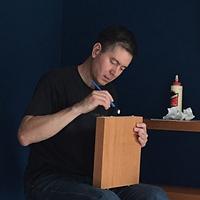
I glued the top and bottom skins first (both at once so I could clamp both faces between my workbench top and a shelf skeleton that hadn't been skinned yet), then the short side edges, and finally the long front faces. I used painter s tape and scraps as clamps and narrow plywood strips as cauls for the edges and faces.
The results weren't perfect, but pretty good. There were gaps in some places (where the bevels weren't perfect, or where the inner bevels didn't align perfectly with the underlying skeleton faces), but nothing too terrible. I filled the largest gaps with sawdust and wood glue. Some of the gaps mostly disappeared when I used sandpaper to ease the edges.
When I finished the shelves with Danish Oil later, I wet sanded one application, and that helped fill any remaining small gaps. Before I cover finishing, I'll describe how the individual shelves, sides, and back panel are connected.
The glue up was not as stressful as the photo with the painter’s tape clamp might make it look. The glue up for each shelf was in two steps: (1) glue on the top/bottom, and (2) after the top/bottom were set, glue on the narrow front/side faces. For (2), the narrow face sat in a trough firmed by the beveled top/bottom edges. That trough further stabilized the pieces (along with the brad nubs).